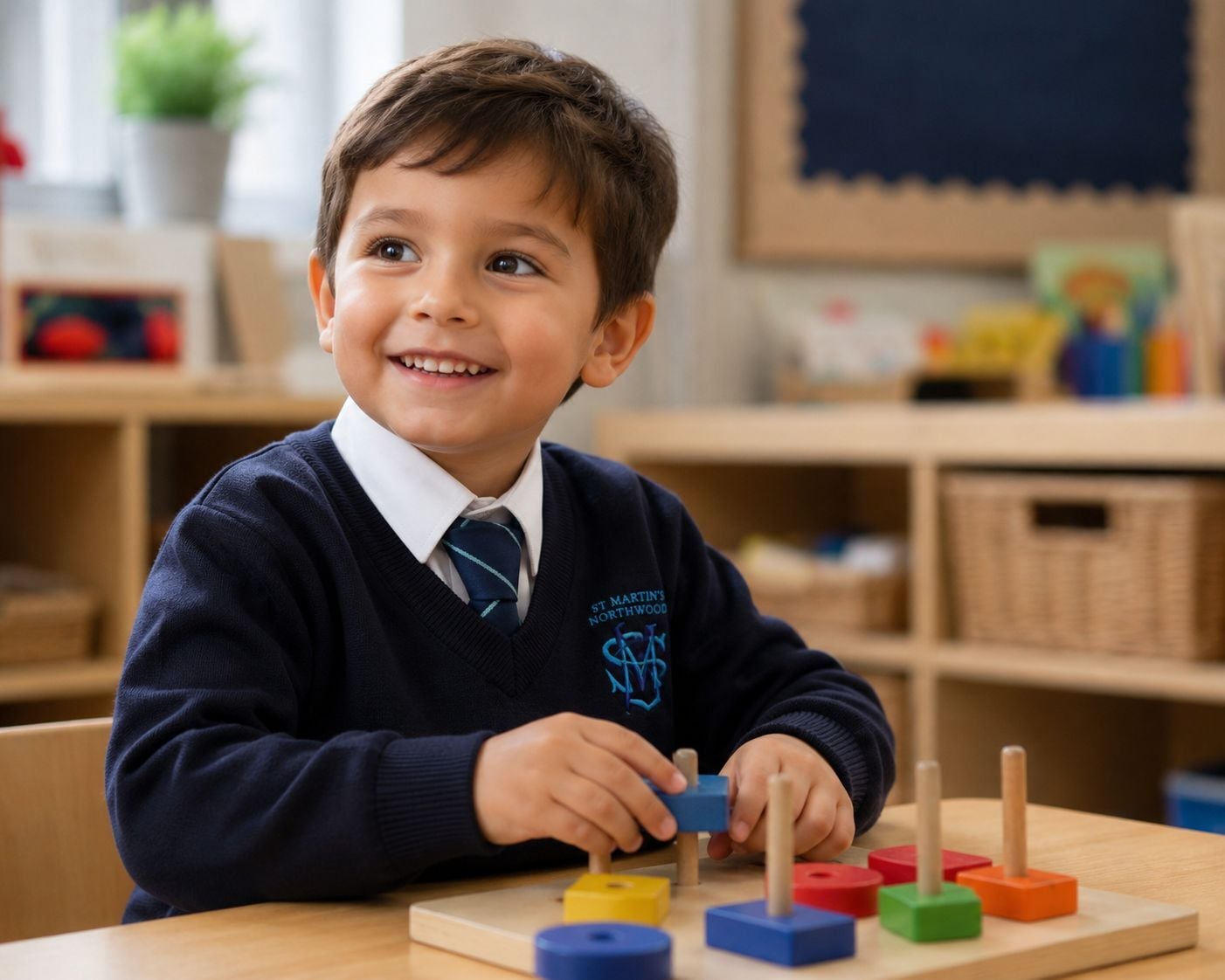
How Neuroscience in Education Supports Child Development
Published on: 6 October 2025
Neuroscience shows us how children’s brains grow, learn and adapt from their earliest years. By applying insights from educational neuroscience, schools like St Martin’s can support your child’s development more effectively, helping them build strong learning habits, emotional balance and resilience.
The brain changes constantly through experience, a process known as neuroplasticity. When we understand how this works, we can create learning environments that encourage curiosity and confidence. Schools that use neuroscience-informed teaching tailor lessons to match how the child and adolescent brain naturally develops.
Here, our child development experts explain how educational neuroscience connects to child growth, how education shaped by brain science enhances learning and how you can apply these ideas at home. You’ll also find out more about our approaches informed by neuroscience at St Martin’s.
Understanding the role of educational neuroscience in child development
Educational neuroscience helps us understand how your child’s brain grows, learns and adapts. By connecting brain science with education, we can support learning environments that match how children’s brains naturally develop and process information.
Foundations of educational neuroscience
Educational neuroscience bridges brain science, psychology and education. It studies how teaching methods affect brain function and how the brain’s structure supports learning. This field explores how experiences shape neural pathways from birth through to adolescence.
You can think of it as a partnership between educational research and practice. Scientists study how children’s brains respond to different learning experiences, while educators apply these findings to classroom and home settings.
For example, educational research on neuroplasticity, the brain’s ability to reorganise and form new connections, shows why early experiences matter. When children engage in play, language and problem-solving, they strengthen neural networks that support later learning.
Educational neuroscience also helps identify effective teaching strategies. By understanding how attention, memory and emotion influence learning, we can create supportive environments that encourage curiosity and resilience.
Key insights from brain development research
During the early years, the brain forms billions of new connections. Studies show that the most rapid synaptic growth happens before age five, laying the foundation for social, emotional and cognitive skills. This period allows children to absorb large amounts of information from their surroundings.
Healthy brain development depends on both genes and environment. Factors such as sleep, nutrition and emotional safety help the brain function at its best. Stressful or neglectful conditions can slow development by affecting brain activity and regions linked to learning and emotion.
Educators and parents can use this knowledge to provide enriched environments – spaces that offer stimulation, predictability and secure relationships. These conditions nurture healthy brain growth and learning readiness.
The science of learning and cognitive growth
The science of learning focuses on how the brain processes, stores and retrieves information. It draws on findings from cognitive neuroscience to explain how attention, long-term memory and motivation shape learning outcomes.
Neuroscientific findings show that learning is experience-dependent. Repeated practice strengthens neural pathways, while lack of use weakens them – a principle known as “use it or lose it.”
Motivation plays a major role. When your child feels competent, autonomous and connected, their brain’s reward system releases dopamine, reinforcing learning. Balanced challenge and support, known as the stretch zone, help sustain engagement and growth.
Teaching that aligns with brain function improves attention, memory retention and emotional wellbeing. By understanding these key findings, you can better guide your child’s learning journey with evidence-based practices.
How neuroscience-informed education enhances child growth
Neuroscience-informed education uses research on how the brain learns to improve teaching and child development. It helps you understand how the environment, emotions and individual differences shape your child’s learning capacity and wellbeing.
Creating optimal learning environments
Children learn best in environments that support neuroplasticity, the brain’s ability to form new connections through experience. A balanced mix of challenge and support helps the brain strengthen learning pathways. When your child feels safe, curious and motivated, their brain is primed for growth.
Practical factors such as sleep, nutrition and physical activity play a major role in brain health. Studies show that enriched environments with sensory, cognitive and social stimulation improve attention and problem-solving. Classrooms designed with movement breaks, natural light and hands-on learning promote optimal learning conditions.
At St Martin’s, our teachers apply insights from educational neuroscience by tailoring lessons to the brain’s natural learning rhythms. This includes alternating focused work with reflection time and encouraging active participation rather than passive listening. These strategies make learning both more effective and more enjoyable for our students.
Supporting emotional and social development
The brain’s social networks develop through positive relationships and emotional safety. Educational neuroscience shows that emotions influence attention, memory and decision-making. When your child feels supported, they are more likely to take risks in learning and recover from mistakes.
Emotional coaching, i.e. helping children name and manage their feelings, strengthens the neural circuits that regulate behaviour. Teachers and parents who model calm responses support the development of emotional control and empathy. This approach aligns with findings from social neuroscience, which highlight the role of connection in cognitive growth.
Collaborative learning and play also shape the social brain. Activities that involve teamwork, shared goals and communication build both social and academic skills. Safe, caring environments help children build resilience and self-confidence, which are key for lifelong learning.
Promoting executive functions and memory
Executive functions, including working memory, flexible thinking and self-control, are central to learning success. These skills help your child adapt to new challenges and stay focused on their schoolwork. Brain imaging research links strong executive functioning to better academic performance and emotional regulation.
We can support these functions through structured routines and games that require planning or problem-solving. For example, memory games strengthen working memory, while goal-setting tasks enhance organisation and persistence. Repetition and practice move information from short-term to long-term memory, reinforcing understanding.
Engaging multiple senses, such as combining movement with verbal instruction, improves memory retention. Encouraging your child to explain what they have learned also strengthens neural connections and deepens comprehension.
Tailoring learning approaches to individual needs
Every child learns differently due to variations in brain development, experience, and genetics. Understanding these differences helps us design learning that fits your child’s unique profile. This approach reflects principles from the psychology of education, which emphasise individualised support.
Children with diverse learning styles may benefit from visual aids, hands-on tasks or verbal repetition. For example, improving phonological awareness supports reading development, especially for children with dyslexia. Educational neuroscience shows that targeted practice can rewire brain activity to improve specific skills.
With small class sizes and specialist teachers, St Martin’s personalises education to each of our individual pupils. Our teachers offer one-to-one support and adapt their methods based on how your child learns best.
Practical applications and strategies for parents
Understanding how the brain develops helps you make choices that strengthen your child’s learning, emotional regulation and wellbeing. By using neuroscience-informed strategies, you can create daily routines that support brain health, encourage curiosity and build upon the neuroscience-backed education they receive at schools like St Martin’s.
Applying educational neuroscience at home
You can use simple activities to support your child’s brain growth. Regular sleep, balanced nutrition and consistent routines help stabilise mood and attention. Encourage open discussion about emotions to strengthen the brain’s self-regulation networks.
Short sessions of cognitive training, such as puzzles, memory games or pattern recognition, can improve their focus and problem-solving. Musical training and spatial training also enhance areas of the brain linked to language and reasoning.
Create a calm environment that limits stress, as chronic stress can interfere with neural development. Use positive reinforcement rather than punishment to guide behaviour. Parents who understand how the brain responds to praise and empathy can better support emotional growth.
Collaborating with educators
You play a key role in linking neuroscience-backed teaching with home learning. Communicate regularly with teachers about your child’s progress and how classroom strategies align with home routines. Many schools like St Martin’s now use learning technologies and brain-based teaching approaches to personalise instruction, so it’s important to collaborate on how you can implement them at home.
Ask your child’s teachers about how lessons incorporate movement, focus breaks and multisensory learning. These methods engage multiple brain regions and help memory retention, which is why we incorporate them into every subject at St Martin’s.
A great opportunity to speak to your child’s teachers about making their experience across education and home consistent is during parents’ evenings or other school events. When parents and teachers share consistent strategies, children experience smoother transitions between learning environments.
Encouraging lifelong learning and brain health
Cutting edge-neuroscience shows that the brain remains adaptable throughout life. Encourage your child to view learning as a continuous process, not just something that happens in school. Support hobbies that require focus and creativity, such as music, art or coding.
Introduce lifelong learning habits early. Reading together, discussing ideas and exploring new topics online or through educational games build curiosity and cognitive flexibility. You can promote their brain health through regular physical activity, social interaction and mindful rest.
Frequently asked questions
Understanding how neuroscience connects to education helps you make informed choices about your child’s learning. It explains how the brain grows, how emotions shape learning and how you can use everyday experiences to support healthy development.
What are the benefits of applying neuroscience principles in early childhood education?
Applying neuroscience in early education helps teachers and parents create environments that match how the brain learns best. During the first years of life, the brain grows quickly and builds strong neural connections.
By using educational neuroscience, educators can design activities that strengthen memory, attention and emotional regulation. These approaches support long-term learning and healthy social development.
How can parents support brain development in their children through educational activities?
You can support your child’s brain development by offering stimulating, hands-on learning experiences. Reading together, exploring nature, solving puzzles and encouraging creative play all strengthen neural connections.
Providing enough sleep, balanced nutrition and regular physical activity also supports healthy brain growth.
What role does play have in cognitive development according to educational neuroscience research?
Play is essential for building problem-solving, language and social skills. Educational neuroscience shows that play activates multiple areas of the brain, encouraging creativity and emotional control.
Through imaginative play, children practise decision-making and self-regulation, which are key functions of the developing prefrontal cortex. Play supports both emotional and intellectual growth, which is why it’s a core part of the St Martin’s early years curriculum.
How does emotional wellbeing impact learning and brain development in children?
Emotional safety and positive relationships are vital for brain development. Stress can limit neuroplasticity, while supportive environments strengthen learning pathways.
When children feel secure and valued, their brains are more open to absorbing new information. Ultimately, emotional well-being lays the foundation for attention, memory and resilience.