What Is STEAM Education? Integrating Academics, Science and Art
Published on: 28 October 2024
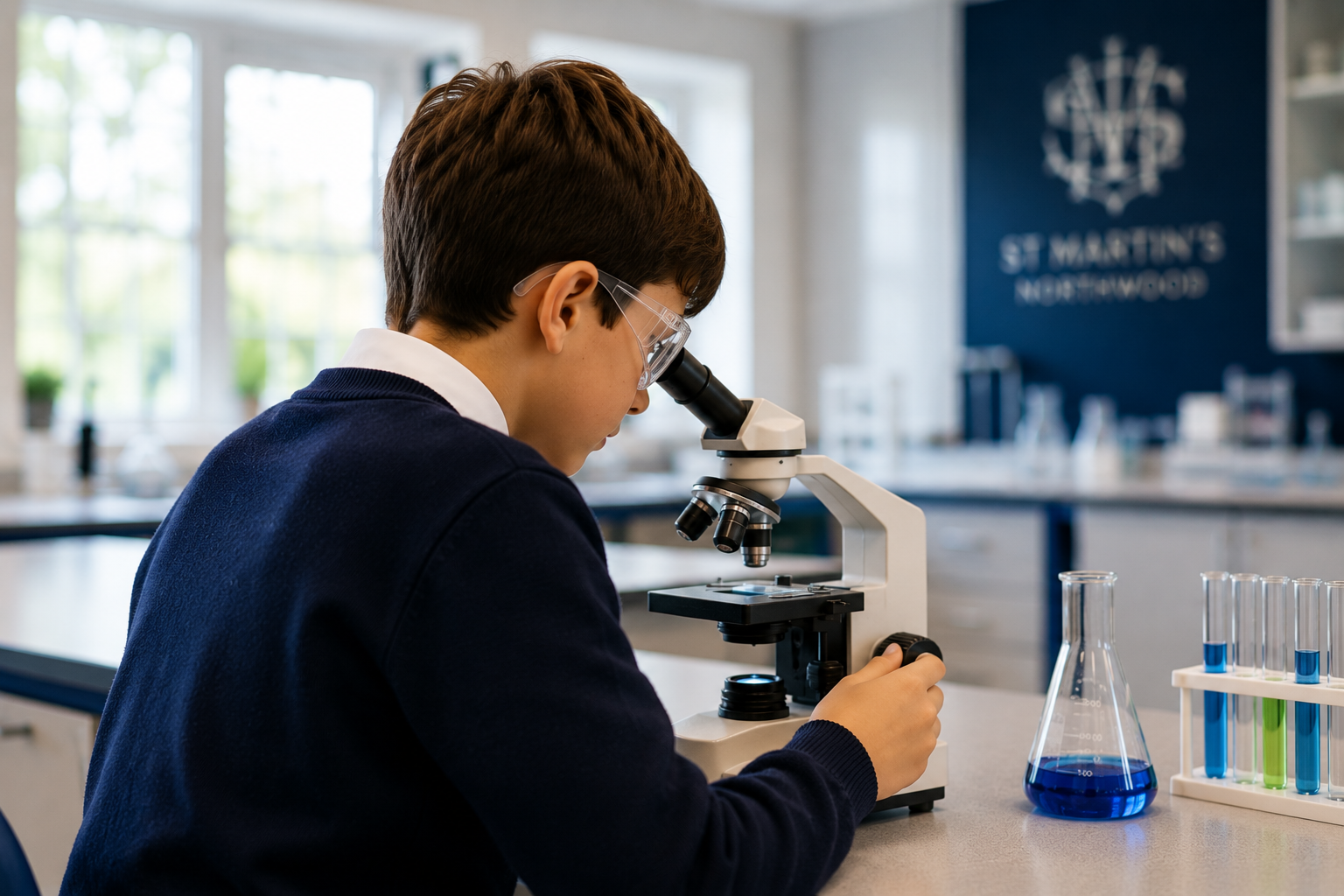
At St Martin’s, we go beyond the traditional but highly important STEM (science, technology, engineering, and mathematics) education, blending it with arts for a uniquely rewarding educational experience.
By integrating the arts with STEM subjects, our STEAM education aims to foster creativity alongside analytical skills. This approach equips pupils with the tools to think critically, solve problems creatively and use technology in innovative ways.
Unlike traditional education models that often separate arts from sciences, STEAM education blends these disciplines, encouraging pupils to explore and innovate by connecting different types of knowledge. It champions an interdisciplinary approach, allowing pupils to see and create broader connections across various fields.
Adopting a STEAM approach not only nurtures academic skills but also promotes personal growth and awareness of how diverse subjects interrelate. By doing so, it prepares our pupils for a future where adaptability and cross-disciplinary collaboration are key.
As we’re not tied to the national curriculum, St Martin’s is able to adopt this innovative approach that perfectly blends academia with creativity and key soft skills, giving our boys a well-rounded education
Key takeaways
- STEAM integrates arts with STEM for creative problem solving.
- It creates an interdisciplinary learning experience.
- This approach enhances both academic and personal growth.
Exploring the pillars of STEAM education
Incorporating an interdisciplinary approach, STEAM education blends science, technology, engineering, art and mathematics. Each pillar contributes uniquely to developing students’ critical skills. Understanding these elements offers invaluable insights into the whole educational framework.
Science and mathematics: foundations of inquiry
Science and mathematics form the bedrock of STEAM education, helping our pupils develop analytical and problem-solving abilities. These fields teach you the art of science and the science of art, encouraging inquisitive thinking.
Scientific knowledge is integral for understanding natural phenomena, while mathematical skills are essential for logical reasoning.
Mathematics provides the language needed for technology and engineering, making it a core component. Pupils engage in quantitative assessments, use statistical data and explore algebraic formulas. This foundation allows our students to approach challenges methodically and find workable solutions by applying math skills.
Technology and engineering: drivers of innovation
Technology and engineering offer practical applications of scientific and mathematical principles, acting as key drivers of innovation. These disciplines enable students to experiment with STEM programming and develop engineering skills.
Gaining technological proficiency deepens pupils’ understanding of contemporary tools and software, which is essential in our digital world. These fields encourage our students to adapt to changing environments, fostering an ability to create innovative solutions. Integrating technology and engineering into education promotes a practical understanding of technological advancements.

Art: enhancing creativity and connection
Art in STEAM enhances creativity and strengthens connections. It nurtures our boys’ artistic skills and creative processes, integrating visual elements into traditional STEM subjects. By involving art, education transitions from rote memorisation to a dynamic learning experience.
Artistic skills, like graphic design, enhance pupils’ ability to express complex scientific concepts visually. This pillar encourages original thought, enabling them to connect disparate ideas in novel ways.
Art blends emotional and intellectual understanding, creating a balanced approach to learning. This enrichment allows for more rounded development in problem-solving and idea generation.
Benefits of a STEAM approach in education
Adopting a STEAM approach via our private school curriculum offers many benefits to our boys. It emphasises both critical and creative thinking skills, equipping future generations with the tools needed to tackle real-world problems.
Fostering critical and creative thinking
STEAM education focuses on nurturing critical thinking skills by encouraging students to question and explore multiple solutions. Through interdisciplinary learning, they develop the ability to merge different fields, such as science and arts, enhancing logical and computational thinking. This innovative approach allows our pupils to discover creative solutions and apply them to complex situations.
Students also learn to work collaboratively, which enhances soft skills like communication and teamwork. This method of teaching challenges you to think outside the box and promotes creative thinking skills, preparing you to address diverse challenges with a well-rounded mindset.

Preparing for the future: skills for an evolving job market
With technological advancements rapidly changing the job landscape, a STEAM approach fills the skill gap by providing essential 21st-century skills. This educational model equips you with abilities like adaptability and problem-solving, crucial for industries focusing on innovation and creativity.
Skills such as critical and creative thinking are in high demand, allowing you to excel in fields requiring complex problem-solving. As the job market transforms, opportunities for students increase when they possess these individual skills. By embracing a STEAM education, our pupils become better prepared to meet the demands of an evolving job market with confidence and competence.
Practical applications of STEAM in classroom settings
Incorporating STEAM education in the classroom requires strategic planning. We design lessons that engage students through project-based activities, while fostering collaboration with community partners.
Designing engaging STEAM lessons
To create meaningful STEAM lessons, we focus on real-world applications. Integrating project-based learning encourages students to explore and solve everyday problems. For example, designing a simple bridge using basic materials connects physics with creativity, underlining the concept of an integrated approach.
We use science experiments that let students learn through hands-on activities relevant to the STEAM curriculum. By embedding STEAM projects in our lesson plans, we offer exceptional curriculum standards while promoting an interdisciplinary education.
It’s important that we keep the classroom environment flexible to accommodate various learning styles. Our lessons combine technology and art to stimulate creativity, allowing students to experience authentic STEM lessons. Intentional teaching strategies in our small classes highlight the connection between academic theories and practical tasks, making the lessons relatable and impactful.

Collaborating with community partners and industries
Establishing partnerships with local businesses and organisations strengthens STEAM education. These community partners provide insights into industry needs and offer real-world contexts for students.
Collaboration can include guest speakers, workshops or site visits that enhance classroom instruction. By working with industry experts, students gain awareness of how STEAM skills apply in various professions. This collaboration helps to build a bridge between theoretical concepts taught in schools and their application in daily life.
Additionally, aligning teaching approaches with community needs can lead to real-world solutions. Engaging students in projects that address local challenges not only motivates them but also makes the learning experience more authentic and meaningful.
Frequently asked questions
STEAM education combines science, technology, engineering, arts and mathematics to foster creativity and critical thinking. It encourages students to explore connections between these areas and provides various educational and career benefits.
What are the core components of STEAM education?
STEAM education involves integrating five key areas: science, technology, engineering, arts and mathematics. Each component plays a crucial role in developing diverse skills. The focus is on interdisciplinary learning, where students engage with concepts across these subjects to gain a comprehensive and interconnected understanding.
How does STEAM education integrate arts with traditional STEM subjects?
The arts in STEAM provide a creative layer, encouraging innovative thinking and problem-solving. By incorporating arts, students can approach STEM subjects more creatively and expressively. This helps in developing new perspectives and solutions by enhancing skills such as design thinking and creativity.
What are the main benefits of implementing STEAM education in schools?
Implementing STEAM education in schools promotes critical thinking, teamwork and experiential learning. Students learn to take risks, solve problems creatively and develop persistence. This educational approach prepares them for the rapidly changing demands of the workforce by cultivating adaptability and resourcefulness.
Can you provide examples of effective STEAM education in practice?
Examples of effective STEAM education include projects where students design and build models, such as bridges or robots, integrating physics and engineering principles. Another example is coding music or digital art projects, combining technology and creativity to produce engaging learning experiences.
What challenges are faced by educators when incorporating STEAM pedagogy?
Educators may face challenges such as limited resources, lack of training and balancing traditional and innovative teaching methods. It can also be difficult to create interdisciplinary lessons that effectively integrate all STEAM components. With our highly trained subject-expert teachers and investment in resources, we’re able to effectively incorporate STEAM into our education.

How does STEAM education influence a student’s future career prospects?
STEAM education enhances career prospects by equipping students with versatile skills valued in the modern workforce. It fosters qualities like creativity, collaboration and critical thinking that are essential in various fields, including technology, engineering and the arts, broadening future career opportunities.