9 Reasons Why Maths Is Important in School
Published on: 16 March 2026
Maths plays a central role in our world, making it an essential subject for children to master in school. From finances to cooking and general problem solving skills, it’s something children will practice every day throughout their lives.
Maths teaches children how to think logically and make sense of the world around them while preparing them for future academic study and career opportunities.
Here, we’ll explain the key reasons maths matters for your child, from building everyday skills like budgeting to developing the foundations needed for science and technology careers. We’ll also share practical ways to support your child’s maths learning through simple activities at home.
1. Practical problem solving and everyday numeracy skills
Maths helps your child handle real situations they face every day. If they work out how much pocket money they need to save for something they want, they’ll use numeracy skills.
Numeracy allows children to understand and use numbers when solving problems or making decisions. Your child will use these skills when they share sweets fairly amongst friends or calculate how much time they have before bedtime.
Problem solving, logic and communication all build on maths foundations. When your child learns to approach a maths question step-by-step, they develop thinking skills that help them tackle other challenges too.
Real-life applications help children develop critical thinking skills whilst showing them why numbers matter. Shopping, cooking and planning journeys all require basic numeracy. These everyday tasks will become easier when your child has strong maths skills to rely on.
The ability to solve practical problems will stay with your child throughout their life, helping them make sensible choices about money, time and resources as they grow older.
2. Building logical reasoning and critical thinking
Reasoning in maths is the ability to make logical links and connections that tackle new problems. When your child learns maths, they develop skills that go far beyond numbers and formulas.
Mathematics helps your child build mental discipline and encourages logical reasoning. These abilities are useful in many areas of life, not just in school subjects.
Mathematical reasoning involves justifying answers with logical support and proving why solutions work through clear thinking. Your child learns to explain their thinking process and explain their conclusions with evidence.
The process of applying logical and critical thinking to mathematical problems teaches children to work out the correct strategy to use. They also learn which approaches won’t work, which is equally important.
These reasoning skills help your child solve complex problems and make informed decisions. The abilities they’ll develop in maths lessons transfer to everyday situations, from planning their time to making choices about money.
When children strengthen their reasoning abilities, they become better equipped to handle challenges both inside and outside the classroom.
3. Supporting progression to GCSEs and further study pathways
Maths builds a foundation that your child needs for GCSE success and beyond. The skills they learn in primary and early secondary school directly prepare them for more advanced mathematical concepts.
GCSE Maths covers key topics including algebra, geometry, statistics and probability. Without a solid understanding of basic maths, your child may struggle with these more complex areas.
Mathematics is a core subject of the national curriculum, and success in mathematics leads to many opportunities for further study and employment. Students who continue studying maths after GCSE open doors to careers in in-demand areas like STEM and finance.
Different pathways exist to lead children through maths to age 18 and beyond. Your child might choose A-level maths, further maths or vocational qualifications like engineering, depending on their interests and goals. Maths skills are particularly important for jobs in a digital-first world, as they are key to in-demand jobs like data analysis and programming.
4. Developing financial literacy
Maths gives your child the skills they need to manage money throughout their life. Financial literacy is a key life skill that builds on basic numeracy.
When your child learns percentages, they’ll be prepared to understand interest rates on savings accounts and loans. Decimals help them calculate prices, discounts and VAT. These are tools your child will use when budgeting their pocket money and, later, their in.
The connection between mathematics and financial literacy is important for developing practical money skills. Your child will practise these skills when they work out how long it takes to save for something they want or compare the cost of something, like different mobile phone contracts.
Schools like St Martin’s place a strong focus on real-life maths skills, including budgeting, debt, interest, mortgages and pensions. The maths behind these topics helps your child make informed decisions about money.
Starting early matters. The sooner your child learns about managing money, the better equipped they’ll be as adults.
5. Boosting confidence through incremental mastery and fluency
Your child’s maths confidence grows when they experience regular success with numbers. Building maths confidence happens through consistent practice and achievable goals that create momentum over time. This is especially important when recent research has shown that parents’ own math anxiety can impact their children’s progress in the subject.
The mastery approach breaks down complex topics into smaller, manageable steps. Your child will learn each concept thoroughly before moving forward. This systematic method builds their knowledge in depth rather than rushing through material.
Fluency in maths involves understanding concepts deeply and applying them flexibly. When your child achieves mathematical fluency, they can solve problems efficiently without anxiety.
Small wins matter greatly in mathematics. Each time your child successfully solves a problem or grasps a new idea, their confidence increases. These victories stack up, creating a positive attitude towards maths that extends beyond primary school.
6. Enhancing STEM readiness for careers in engineering, computing and science
Maths forms the foundation for your child’s future STEM career opportunities. Strong mathematical skills prepare them for jobs in science, technology, engineering and computing fields.
As of 2023, approximately 9.4 million people were employed in STEM jobs in the UK. This sector continues to grow and offer rewarding career paths for young people with solid maths abilities.
Your child will need maths to understand physics concepts, write computer code and design engineering solutions. Without these skills, they may not be able to access careers in STEM.
Schools like St Martin’s focus on developing problem-solving and critical thinking abilities through STEM education. These competencies rely heavily on mathematical thinking. Your child will build confidence in maths whilst exploring real-world applications in technology and science.
Starting maths education early gives your child the best chance to pursue these careers. They develop the analytical mindset needed for complex challenges in engineering and computing roles.
7. Improving data interpretation and statistical awareness
Your child needs to understand data in today’s world. Statistical literacy is a highly valued skill, and schools like St Martin’s embed this into their maths curriculum.
Data interpretation helps your child make sense of information they encounter daily. These skills give them the skills to understand news reports, research findings and everyday statistics.
In primary school, your child will start with basic data collection and simple charts. As they progress to secondary school, data analysis skills become more sophisticated. They work with detailed statistical tools and learn to analyse slope and correlation in data sets.
Building a strong foundation in statistical proficiency should begin in the primary years. Early instruction prepares your child to access complex ideas later on. This foundation supports their ability to question claims, evaluate evidence and make informed decisions based on data rather than assumptions.
8. Encouraging perseverance and productive struggle in learning
Mathematics teaches your child that struggling with a problem is a normal part of learning. When students work through challenging maths tasks, they develop important problem-solving skills.
Productive struggle in mathematics helps children build resilience and creative thinking. Your child will learn that effort and persistence matter just as much as getting the correct solution.
This type of struggle is different from frustration. It means your child is working hard on a problem that’s challenging but still achievable with effort. Perseverance and effort are just as important as solving the problem itself.
When children push through difficult maths concepts, they’ll understand the material at a deeper level. They’ll also gain confidence in tackling future challenges, both in school and in life.
You can support this at home by praising your child’s effort as well as their results and encourage them to keep trying different approaches when they’re stuck. This builds the mental strength they’ll need throughout their education.
9. Strengthening spatial awareness and measurement skills
Spatial reasoning is essential for mathematics learning, as it helps your child understand how objects move and relate to each other in space.
Your child will use these skills when reading number lines, working with patterns and interpreting graphs. Spatial thinking matters for understanding measurements and grasping how numbers work in the real world.
Research shows children who are good at spatial tasks perform better in maths overall. Training children’s spatial abilities improves maths performance, with studies showing significant gains.
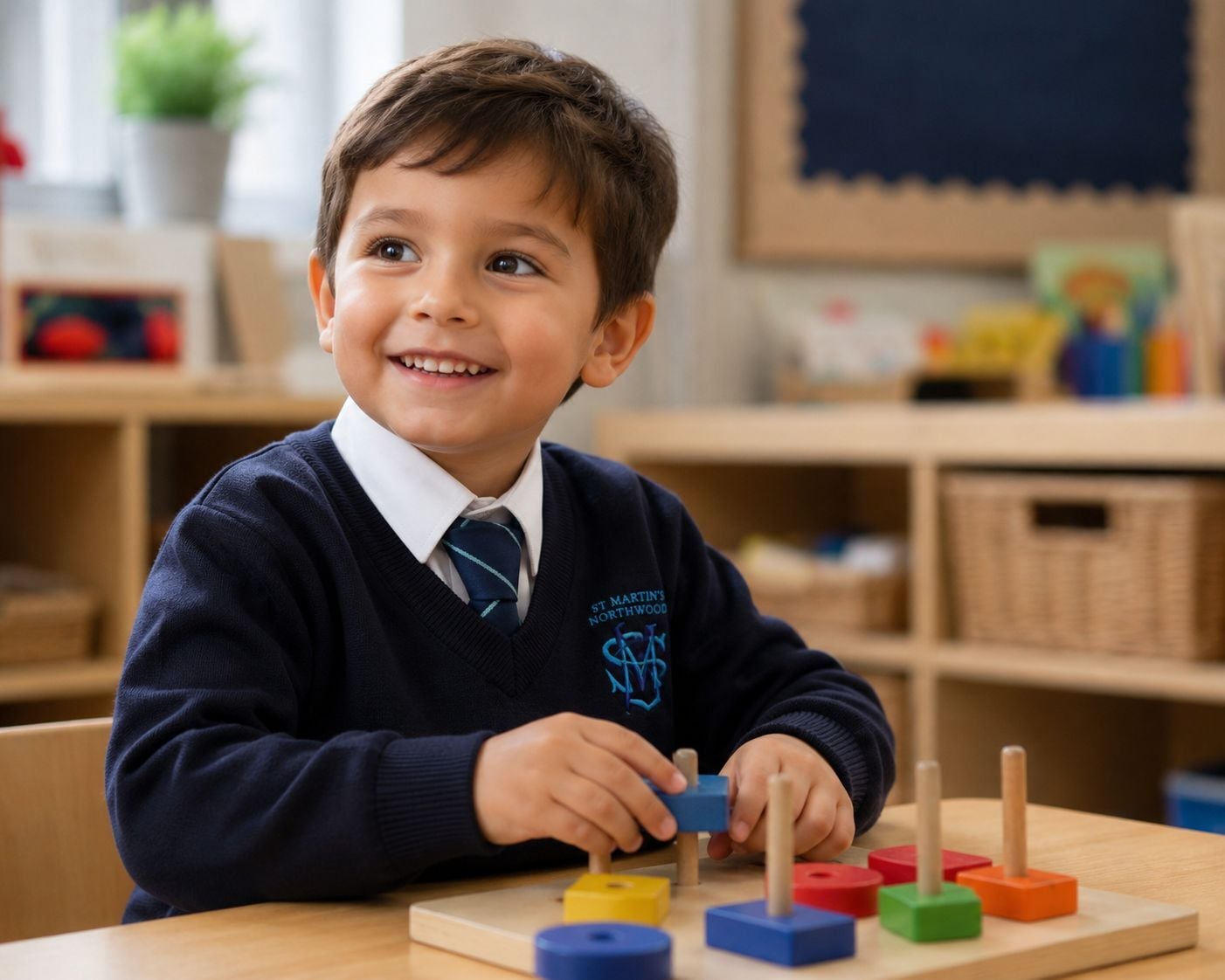
At St Martin’s, we help young children develop spatial concepts through everyday play with shape-sorters and building blocks. These activities teach them about the physical properties of objects and how things fit together.
Frequently asked questions
Parents often have questions about how maths learning works in schools and how they can help at home. These answers address common concerns about supporting children’s mathematical development and making maths a positive experience for the whole family.
How does learning maths in school benefit children beyond the classroom?
Maths skills help children handle everyday tasks like managing pocket money, comparing prices while shopping and understanding time. These practical numeracy skills become essential as children grow older and need to budget, understand taxes and make sense of interest rates on savings or loans.
Logical reasoning developed through maths extends into other subjects and real-world decisions. When children learn to break down problems into steps and test different solutions, they’ll build critical thinking skills that apply to science projects, planning activities and solving everyday challenges.
The progression from basic arithmetic to GCSEs and further study pathways opens the doors to many careers in STEM, which are more in-demand than ever in a digital-first world.
What practical ways can parents support maths learning at home?
You can integrate maths into daily routines without formal lessons. Cooking together involves measuring ingredients, halving or doubling recipes and working with fractions.
Shopping trips offer chances for children to estimate totals, calculate discounts and compare unit prices. Let your child handle money at the till to practise counting and working out change.
Playing board games, card games and puzzles at home develops number sense naturally. Even activities like planning journey times or measuring for DIY projects reinforce mathematical thinking.
How can families build confidence and reduce anxiety around maths?
Show a positive attitude towards maths even if you found it difficult at school. Children pick up on parents’ math anxiety, and it can even negatively impact their maths performance, so avoiding phrases like “I was never good at maths” helps prevent passing on negative feelings.
Praise your child’s effort and progress as well as correct answers. When children see mistakes as learning opportunities rather than failures, they develop resilience and willingness to tackle challenging problems.
Break tasks into smaller steps so children experience regular success. This incremental mastery creates a sense of achievement that motivates further learning.
What are effective family engagement activities that make maths enjoyable?
Family activities that make maths fun include cooking, gardening, DIY tasks and games. Cooking and baking involve weighing, measuring, timing and adjusting quantities. These activities show children that maths is useful, whilst allowing you to create something enjoyable together.
Garden projects require measuring spaces, calculating areas for planting and tracking plant growth over time. DIY tasks like building furniture or redecorating, meanwhile, involve measuring, calculating materials needed and working with shapes.
Planning family outings together involves budgeting, working out distances and journey times, and scheduling activities. Finally, sports and games provide natural opportunities to keep score, calculate averages and work with statistics in contexts children find engaging.